
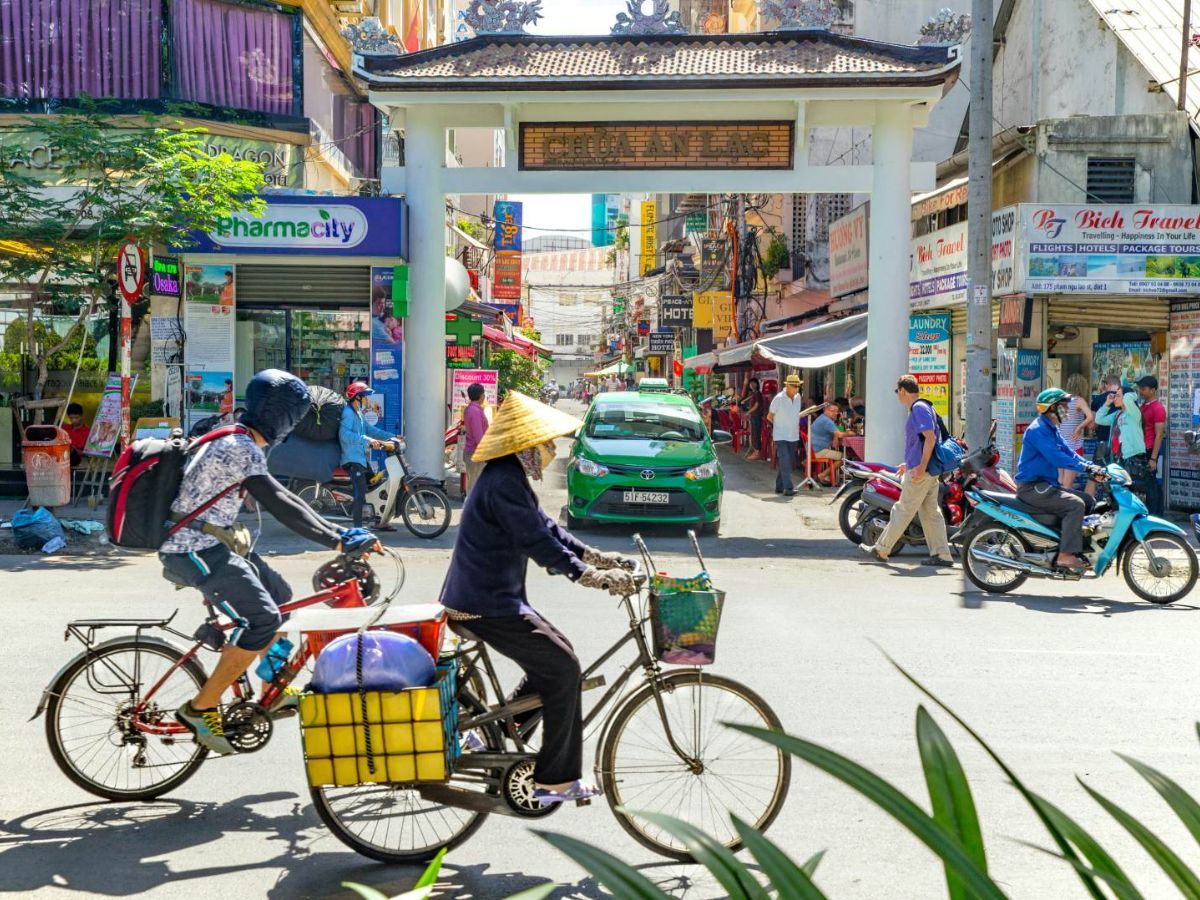
When students arrive in Vietnam, they often notice movement first. Motorbikes, vendors, cafés, delivery riders, market stalls, small shops, construction sites, service workers and informal transactions appear close together. At first, this can feel like background atmosphere: local colour around the formal program.
For business learning, that background matters. The street can show how enterprise actually works under constraint. It reveals how people use limited space, how businesses position themselves, how customers decide quickly, how suppliers move goods, how digital tools mix with older habits, and how economic life continues through constant adjustment.
The street is not outside the business system
In many programs, students move past street-level commerce on the way to a more formal visit. They may notice it, photograph it, talk about how busy it feels, and then enter a meeting room to discuss business in more recognizable terms. That separation is understandable, but it can weaken the learning.
Street-level enterprise is not outside the economy. It is one of the places where students can see the economy functioning directly. A food vendor manages procurement, preparation, customer flow, pricing, waste and reputation. A small shop manages stock, credit, display, neighbour relationships and family labour. A market stall manages perishability, competition, bargaining, supplier trust and seasonal demand.
These are business decisions. They may not use the same vocabulary as a startup pitch or business school case, but they can teach students a great deal about how enterprise works in practice.
Family enterprise and local trust
Family businesses are one of the most important contexts for students to observe in Vietnam. They are not always easy to access formally, and they should not be turned into objects of curiosity. But when approached carefully, they can help students understand how business is embedded in household life, neighbourhood relationships and long-term trust.
Students can examine how labour is shared, how roles are learned, how decisions are made, how customer relationships are maintained, and how a business survives through habits that may not appear in a formal management structure. They can also see the limits: succession pressure, capital constraints, changing consumer expectations, rent, regulation, competition and the difficulty of scaling without losing what made the business work.
This is especially useful for entrepreneurship education because it complicates the assumption that all enterprise aims to become a scalable venture. Some businesses are designed to sustain a household, support a community role, or remain flexible enough to survive uncertainty.
Markets as business classrooms
Markets are often used in student programs as cultural stops. Students taste food, observe colours and movement, and perhaps learn a few ingredients. That can be enjoyable, but it is only the surface. A market can also be read as a dense business system.
Students can look at how products are grouped, how price changes through the day, how vendors use visibility and repetition, how fresh goods depend on timing, how waste is handled, how trust is signalled, and how the market connects rural production with urban consumption. In a business or entrepreneurship course, these observations can connect to supply chains, consumer behaviour, informal finance, logistics, food systems and service quality.
The key is framing. Without a question, a market is only a sensory experience. With the right question, it becomes a field site where business systems are visible.
Cafés, brands and consumer identity
Vietnam’s café culture is another useful business context. A café is not only a place to drink coffee. It is a space where students can observe brand identity, customer segmentation, design, location strategy, pricing, social behaviour, remote work habits, youth culture, franchise models and local adaptation.
Different cafés speak to different customers. Some emphasize convenience, others atmosphere, productivity, heritage, status, affordability, aesthetics or local familiarity. Students can compare how space is used, how people occupy it, how menus are designed, how staff interact with customers, and how local brands compete with international expectations.
This kind of observation helps students understand that consumer markets are not abstract. They are lived through space, routine, identity and habit.
Startups still matter, but they need context
Formal startup visits can be valuable when they are chosen carefully. Founders can speak about product development, hiring, funding, market entry, regulation, talent, partnerships and scaling. Incubators and innovation spaces can show how entrepreneurship support is organized. University-linked initiatives can connect student learning with local ecosystems.
But startups are more useful when students have already observed the broader business environment. A founder’s comments about customer acquisition mean more after students have watched consumer behaviour. A discussion of logistics means more after students have seen how goods move. A conversation about digital platforms means more after students have noticed delivery riders, payment habits and platform-mediated services in daily life.
Context turns a startup visit from an inspirational story into a case that students can actually interpret.
Supply chains and logistics at visible scale
Vietnam also allows students to connect entrepreneurship with production and movement. Not every program can visit factories or ports, and those visits require careful preparation. But even without heavy industrial access, students can observe how goods, food, people and services move through the city and region.
For business students, this matters because entrepreneurship does not happen only at the point of sale. It depends on sourcing, storage, timing, transportation, infrastructure, labour, regulation, capital and the ability to adjust when one part of the system changes. A product on a shelf, a meal in a market or a delivery arriving at a café all sit inside wider systems.
Vietnam makes many of those systems visible enough for students to begin asking better questions.
What students should be asked to do
Students do not automatically learn from observation. They need tasks that help them look without turning people into spectacle. A good field structure may ask students to map flows, compare business models, identify constraints, observe customer behaviour, trace supply questions, document service interactions, or compare what they see in informal and formal settings.
The work should be respectful and bounded. Students should not interrupt businesses without permission, photograph people carelessly, or treat local commerce as a performance for outsiders. The role of the local partner is to help design observation that is ethical, useful and realistic.
The best field tasks are often simple. They do not ask students to solve Vietnam. They ask students to notice, compare, question and connect.
Why this matters for business education
Business education can become too abstract when students only encounter models, cases and formal presentations. Field learning brings the friction back. It shows that business decisions are shaped by heat, traffic, trust, timing, family, regulation, rent, language, labour, infrastructure, culture, technology and uncertainty.
Vietnam is useful because these forces are often visible within a short program. Students can see polished modernity and improvisation in the same day. They can meet formal organizations while also observing the everyday enterprise around them. They can begin to understand that business in a fast-changing market is not only about opportunity, but about reading context well enough to act responsibly.
For Scivi, that is the value of using Vietnam as a business field site. The goal is not to show students a destination. It is to help them read the systems that make enterprise possible, and the constraints that shape what people actually do on the ground.